Replacing windows in a Toronto home built in 1910 is a fundamentally different universe from replacing them in a home built in 2010.
For owners of Victorian, Edwardian, or mid-century modern homes in neighbourhoods like Cabbagetown, Rosedale, or The Annex, windows aren't just apertures for light; they are the "eyes" of the architecture. You start the process because of the usual suspects: a draft that makes the living room unusable in January, a staggering gas bill, or the frustrating sight of condensation rotting your interior sills.
But the moment you call a standard window company, you hit a wall. You hear about "Heritage Permits," "profile matching," and the "Ontario Heritage Act." Suddenly, a simple home improvement project turns into a high-stakes negotiation between 21st-century energy standards and 19th-century aesthetics.
In 2026, as Toronto tightens its Net-Zero targets and heritage boards become more sophisticated in their digital surveillance of streetscapes, navigating these rules is no longer optional. It is the difference between an investment that doubles your home’s curb appeal and a legal nightmare involving forced reversals.
The Quick Answer for 2026
- Is a Heritage Permit required? Yes, if your property is "Designated" (Part IV) or within a "Heritage Conservation District" (Part V). Even if it is only "Listed," changes to the street-facing facade are highly scrutinized.
- Can I use modern, efficient windows? Yes, but they must be "contextually appropriate." This usually means high-end wood or aluminum-clad wood with ultra-slim profiles. Vinyl is almost universally rejected for heritage facades.
- What is the "Heritage Premium"? Expect to pay 40% to 100% more than standard window replacements due to custom fabrication, permit overhead, and specialized installation.
- Is restoration better than replacement? In 2026, with the rise of Vacuum Insulated Glass (VIG), restoring the original sash and replacing only the glass is often the most cost-effective and permit-friendly path.
Heritage vs. Modern Window Replacement: The 2026 Reality Gap
The biggest shock for homeowners is the loss of "Consumer Sovereignty." In a standard home, you choose the colour, the material, and the opening mechanism based on your budget. In a heritage home, the City of Toronto acts as a co-designer.
Why Heritage Window Replacement is Fundamentally Different
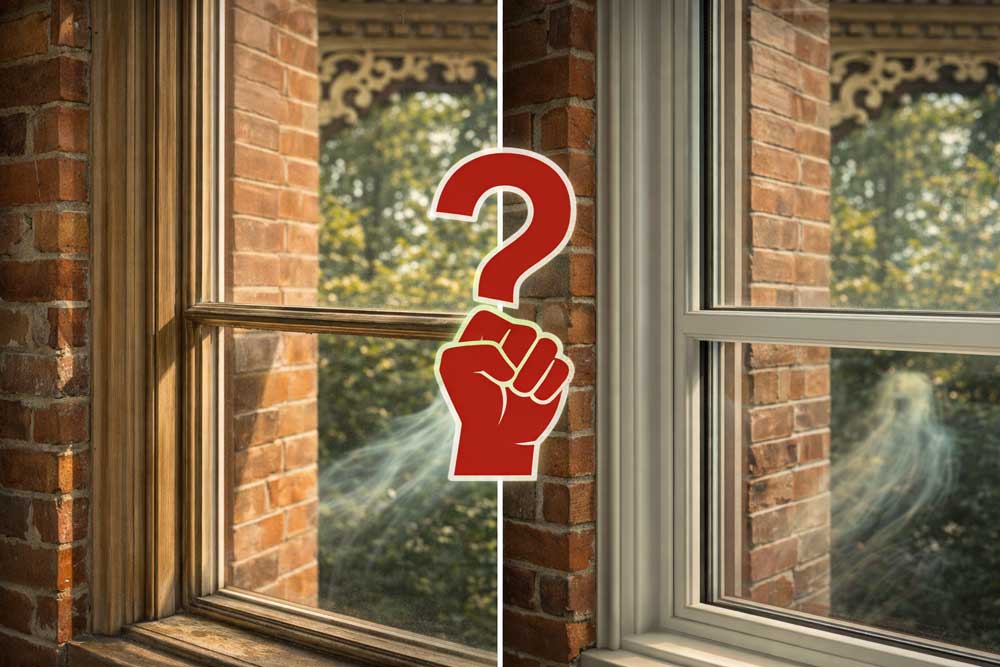
The core misconception many Toronto homeowners have is that if a window looks old, it’s heritage-compliant. In 2026, heritage officers aren't just looking at the shape; they are looking at the "material integrity" and "shadow lines."
The Philosophy of "The Eyes of the House"
In a detached home in North York, you own the exterior envelope. In a designated heritage home in Lawrence Park, you are technically a steward of a historical asset. The Ontario Heritage Act treats the facade as a public good. Windows are critical because they define the "rhythm" of the house.
When you replace a thin, 100-year-old wooden frame with a thick, multi-chambered vinyl frame, the "glazing pocket" moves. This changes how shadows fall on the glass, making the house look "flat" or "plastic." In the eyes of the city, this is a degradation of the property’s historical value.
The 2026 Regulatory Landscape: Net-Zero vs. Preservation
2026 marks a turning point in Toronto’s building code. The city’s push for Net-Zero 2040 means that even heritage homes are being pushed to achieve higher R-values. This has created a friction point: how do you fit a 1-inch thick triple-pane glass unit into a frame designed for 3mm single-pane glass?
This conflict is where most projects fail. Without a specialized consultant or a manufacturer who understands heritage profiles, homeowners often find themselves stuck between a building code that demands efficiency and a heritage board that forbids the bulkiness required to achieve it.
Neighbourhood Nuances: Not All Heritage is Equal
The "rules" change depending on where you live in Toronto. The city manages dozens of Heritage Conservation Districts (HCDs), each with its own specific plan.
- Cabbagetown & The Annex: These neighbourhoods have some of the strictest "like-for-like" requirements. If your original window was a weighted double-hung sash made of Douglas Fir, the board will strongly resist anything that isn't a weighted double-hung sash made of wood.
- The Distillery District: Here, the focus is on "Industrial Heritage." Windows are often large, steel-framed, and multi-paned. The challenge here is "Thermal Breaking", finding metal windows that don't sweat in the winter while keeping the ultra-thin steel profile.
- Mid-Century Modern (e.g., Don Mills): In 2026, we are seeing a surge in heritage designations for homes built in the 1950s and 60s. Here, the focus is on "uninterrupted views" and "minimalist frames." Replacing these often requires high-end aluminum systems that maintain the "California Cool" aesthetic without the massive heat loss of the original single-pane glass.
Don't Risk a "Forced Reversal"
Heritage Planning is notoriously strict. A single mistake in frame profile or material choice can lead to a costly removal order. Before you commit to a manufacturer, let us review your building's specific heritage designation requirements.
Get a Free Heritage Feasibility Review
Technical Deep-Dive: Profiles, Shadow Lines, and VIG
One of the most important technical terms you will hear in 2026 is The Profile.
The "Shadow Line" Test
Old windows were made with very thin wooden members (muntins). When the sun hits them, they cast deep, sharp shadows on the glass. Modern windows often use "Internal Grilles" (bars trapped between two panes of glass). Heritage boards hate internal grilles. They look fake because they don't cast a shadow on the exterior.
To pass inspection in 2026, you must use Simulated Divided Lites (SDL), bars that are permanently bonded to the outside of the glass, giving the illusion of separate panes.
The 2026 Game Changer: Vacuum Insulated Glass (VIG)
For years, the only way to get a heritage window to be efficient was to make it thick and ugly. VIG technology changed that.
VIG consists of two sheets of glass with a vacuum sealed between them. Because a vacuum doesn't conduct heat, the glass can be as thin as 6mm to 8mm while providing the insulation of a 40mm triple-pane unit. This allows us to put high-performance glass into original or reproduction thin-profile wooden frames.
Pro Tip: In 2026, if a contractor doesn't mention VIG for your heritage home, they aren't up to date on the best technology for older Toronto properties.
Material Options: What is Actually Allowed?
In 2026, the material list for heritage-compliant windows is narrow but high-performance.
- Solid Wood (The Gold Standard): Most boards will only accept wood. However, "white pine" is no longer the standard. High-performance woods like Accoya (acetylated wood) are now the 2026 favourite because they don't rot, don't swell, and carry 50-year warranties.
- Aluminum-Clad Wood: This is the "compromise" material. The interior is beautiful wood, while the exterior is a thin layer of extruded aluminum. The city will often approve this if the aluminum is painted in a matte heritage colour and the joints are "mitered" to look like wood joinery.
- Heritage-Grade Fibreglass: Some "Listed" (but not "Designated") homes are beginning to use high-end fibreglass. It’s more stable than vinyl and can be painted, but it still struggles to match the sharp "beaded" details of traditional wood moulding.
The Heritage Permit Marathon: Navigating the 2026 Approval Process

In Toronto, the "Heritage Permit" is not a suggestion; it is a legal requirement under the Ontario Heritage Act. In 2026, the process has become more digitized but also more rigorous. You aren't just filing paperwork; you are building a case.
1. The Pre-Consultation Phase
Before you spend a dime on manufacturing, you (or your architect) should engage in a pre-consultation with a Heritage Planner. In 2026, many homeowners are using 3D LiDAR scans of their existing facades to present a "digital twin" to the city. This level of detail shows the planner that you respect the original geometry of the building.
2. The Documentation Package
A successful application in 2026 requires more than just "before and after" photos. Your package must include:
- Condition Report: Evidence that the current windows are "beyond economical repair." If the wood is just dry but not rotted, the city may push for restoration instead of replacement.
- 1:2 Scale Drawings: These drawings must show the "muntin" profiles, the "sill" depth, and the "brick-mould" width.
- The "Contextual Statement": A brief explanation of how the new windows will enhance the streetscape of your specific neighbourhood (e.g., The Beach vs. Rosedale).
3. The Wait Time
Expect the permit process to take 4 to 7 months. In 2026, the City of Toronto's heritage department is understaffed, and every application is scrutinized. Starting your planning in the Fall for a Summer installation is the only way to avoid frustration.
To Repair or To Replace? The 2026 Financial Analysis
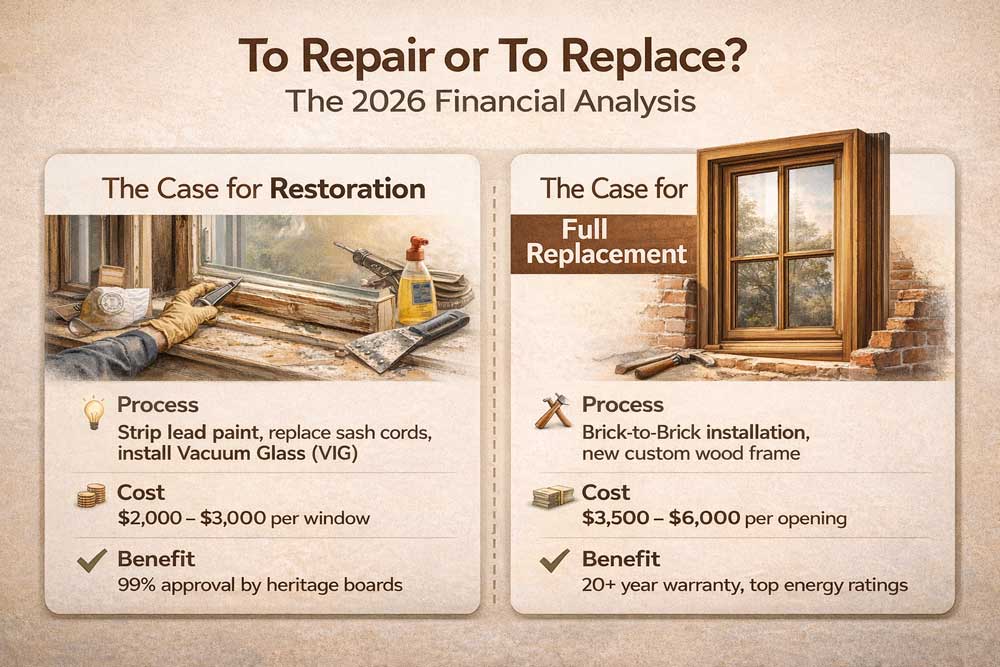
One of the biggest debates in Toronto’s older neighbourhoods is whether to scrap the old windows entirely or "Retrofit" them.
The Case for Restoration
If your home has original, old-growth Douglas Fir or White Oak windows, they are often higher quality than anything you can buy today.
- Restoration Process: This involves stripping lead paint, replacing sash cords with stainless steel chains, and "routing out" the wood to accept a thin Vacuum Insulated Glass (VIG) unit.
- Cost: Restoration often costs $2,000 - $3,000 per window.
- The Benefit: It is almost 100% guaranteed to be approved by heritage boards because you are keeping the original fabric of the house.
The Case for Full Replacement
When the rot has reached the "structural" parts of the window frame, replacement is the only path.
- Replacement Process: A "Brick-to-Brick" installation where the entire wooden box is removed and a new custom-built timber window is inserted.
- Cost: High-end heritage replacements in 2026 range from $3,500 to $6,000 per opening.
- The Benefit: You get a full manufacturer’s warranty (often 20+ years) and the highest possible energy performance (U-factors as low as 0.8).
Cost Analysis: Why Heritage Projects Carry a Premium
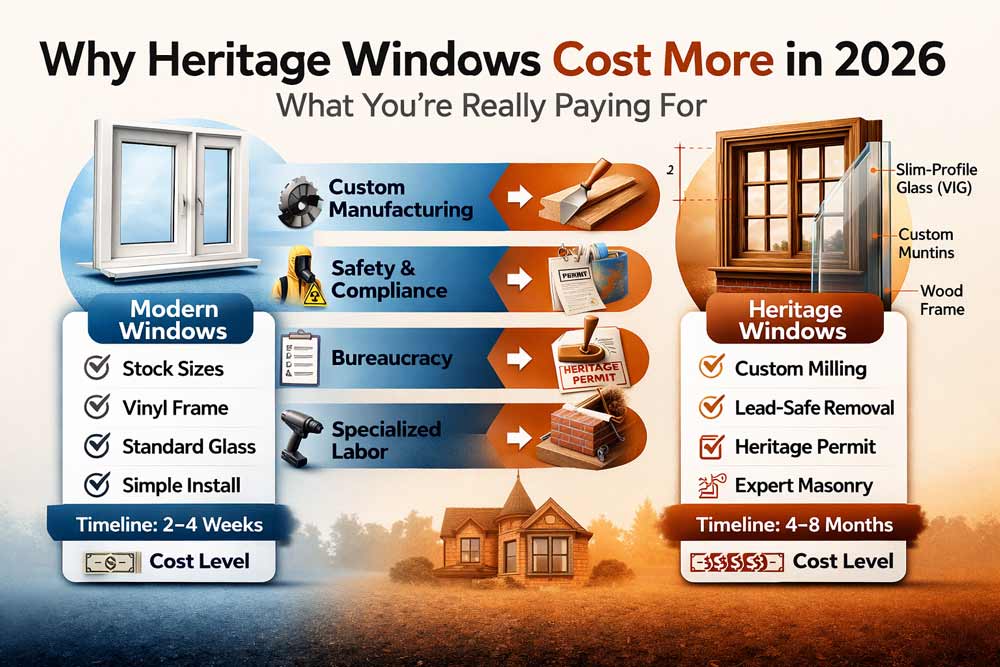
In 2026, the "Heritage Premium" is driven by three factors that don't exist in modern suburban renovations.
1. The "Custom Knife" Factor
Standard window companies use "stock" mouldings. Heritage homes have unique mouldings that were often hand-carved or milled 100 years ago. A heritage manufacturer has to grind a custom "knife" for their milling machine just to match your specific trim. This alone can add $1,000 to a project’s setup costs.
2. Lead and Asbestos Mitigation
Almost every window in Toronto built before 1960 contains lead paint. In 2026, Ontario’s Ministry of Labour has strict "containment" rules. Your installers must build a "clean room" around each window during removal to prevent lead dust from entering your home. This adds roughly 15% to the labour cost.
3. Masonry Protection
In older homes, the windows often help support the "header" of the brickwork. A standard "rip and flip" installer can cause the brick lintels to sag. Heritage installers use specialized shoring and "non-destructive" removal techniques that take three times longer than a standard install.
2026 Rebates and Incentives: Clawing Back the Cost
The good news for 2026 is that the City of Toronto and the Federal Government have aligned their rebate programs to favour heritage homeowners who choose "Sustainable Preservation."
- The Toronto Heritage Grant Program: This can cover up to 50% of the cost of window restoration or high-quality replacement (up to certain limits) for designated properties.
- The "Carbon-Lock" Bonus: In 2026, new incentives exist for choosing Wood over Aluminum or Vinyl, as wood acts as a carbon sink.
- H.E.L.P. (Home Energy Loan Program): The city offers low-interest loans (often 2% or less) that are attached to your property tax bill, allowing you to spread the cost of heritage windows over 15 years.
Common Pitfalls: How to Avoid a "Forced Reversal"
A "Forced Reversal" is a nightmare scenario where the city discovers you installed unapproved windows and orders you to remove them. We are seeing more of this in 2026 due to Google Street View and AI-driven permit audits.
- Falling for the "Heritage-Style" Marketing: Many companies sell windows labelled "Heritage," but they aren't approved by Toronto Heritage. "Style" is not "Compliance."
- Changing the "Swing": Replacing a "Fixed" window with an "Awning" or "Casement" window changes the building's reflection patterns. If the original was fixed, the new one usually must be fixed.
- The "Black Window" Trap: While black frames are the 2026 trend, they were extremely rare in Toronto before the 1950s. If your home is Victorian, a black window might be rejected in favour of "Dark Ivy," "Deep Burgundy," or "Chocolate Brown."
Final Thoughts: The Stewardship of History
Replacing windows in a Toronto heritage home is a project of stewardship. It requires a pivot from the "fast and cheap" mindset of modern construction to the "slow and precise" mindset of craftsmanship.
In 2026, the tools to make these homes comfortable are better than ever. VIG glass, Accoya wood, and LiDAR scanning have closed the gap between history and performance. Success lies in the details: the thickness of the muntin, the colour of the spacer bar, and the patience to navigate the city’s bureaucracy.
Owners who approach the process strategically, valuing the "Shadow Line" as much as the "R-Value", don't just save on energy bills; they protect a legacy that will stand for another century.
FAQ: Heritage Window Replacement 2026
Can I put a screen on a heritage window?
Yes, but the city prefers "disappearing" roll-screens or high-transparency mesh that doesn't obscure the historical details of the frame.
Is triple-pane glass required by the 2026 code?
The code requires a certain "Thermal Performance." While triple-pane is one way to get there, Vacuum Insulated Glass (VIG) is often preferred for heritage homes because it achieves the same result with half the thickness.
What if I only want to replace the windows in the back of the house?
You still need a permit. However, Heritage Planners are generally much more lenient with "Rear Elevations" that aren't visible from the street. This is often where you can save money by using high-quality fibreglass or aluminum-clad wood.
Ready to Move Forward Without the Regulatory Headache?
The path to heritage-compliant window replacement is paved with technical drawings and municipal bylaws. You don't have to walk it alone.
If you want a site-specific heritage assessment, including a breakdown of your HCD requirements, a custom profile-match analysis, and a realistic 2026 cost estimate, let's get started.